
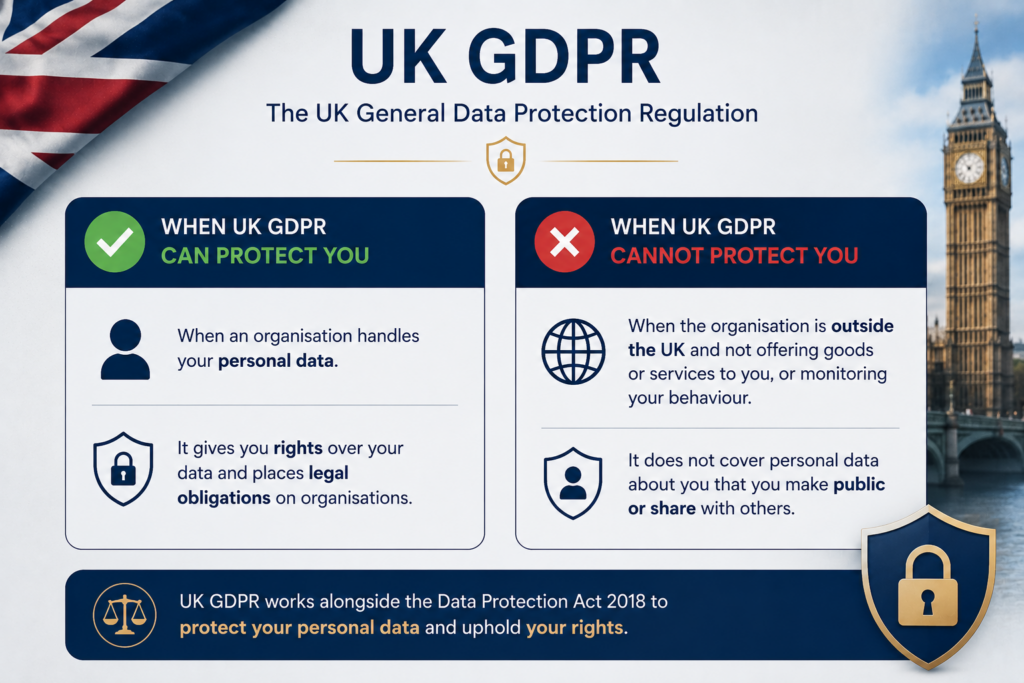
The UK General Data Protection Regulation, commonly known as UK GDPR, is one of the strongest privacy frameworks in the world. It gives people more control over how organisations collect, store and use their personal information. It also places strict responsibilities on businesses, public bodies and other organisations that process data.
But despite its reputation, UK GDPR is not a complete shield against misuse, surveillance or poor data practices. Many people assume it protects all personal information in every situation. It does not.
Understanding both the strengths and the limits of UK GDPR is essential if you want to know your rights and how to exercise them effectively.
What Is UK GDPR?
UK GDPR is the United Kingdom’s version of the European Union’s GDPR, retained after Brexit and adapted into domestic law. It works alongside the Data Protection Act 2018.
The law applies whenever an organisation processes personal data. “Personal data” means information that can identify you directly or indirectly. This includes:
- Names
- Email addresses
- Phone numbers
- IP addresses
- Location data
- Financial details
- Medical records
- Online identifiers and cookies
In practice, almost every modern organisation handles personal data in some form.
Your Main Rights Under UK GDPR
UK GDPR gives individuals several important rights designed to improve transparency and accountability.
The Right to Be Informed
Organisations must tell you what data they collect, why they collect it and how it will be used. This information is usually found in a privacy notice or privacy policy.
The explanation must be clear and accessible. Companies cannot hide important details in deliberately confusing legal language.
The Right of Access
You can ask an organisation for a copy of the personal data it holds about you. This is known as a Subject Access Request.
In most cases, organisations must respond within one month and cannot normally charge a fee.
This right can reveal:
- What information is stored
- Where it came from
- Who it has been shared with
- How long it will be kept
The Right to Rectification
If your data is inaccurate or incomplete, you can ask for it to be corrected.
This matters more than many people realise. Incorrect information can affect credit decisions, insurance quotes, employment records and healthcare treatment.
The Right to Erasure
Often called the “right to be forgotten”, this allows you to request deletion of your personal data in certain circumstances.
For example, you may be able to ask a company to delete data when:
- The information is no longer necessary
- You withdraw consent
- The data was processed unlawfully
However, this right is not absolute. Organisations may still keep data if they have legal or legitimate grounds to do so.
The Right to Restrict Processing
You can ask an organisation to temporarily stop using your data while a dispute or investigation is ongoing.
This can be useful if you challenge the accuracy of information or object to how it is being used.
The Right to Data Portability
You can request certain data in a format that allows you to move it to another provider.
This right mainly applies to digital services and can make switching providers easier.
The Right to Object
You can object to certain types of processing, particularly direct marketing.
If a company uses your data for marketing and you object, they must usually stop.
Rights Related to Automated Decision-Making
UK GDPR offers some protections against decisions made solely by automated systems, especially when those decisions significantly affect you.
Examples include:
- Automated credit scoring
- Recruitment filtering systems
- Fraud detection tools
You may have the right to request human review.
How UK GDPR Protects You in Everyday Life
The law affects far more than spam emails and cookie banners.
Stronger Security Requirements
Organisations must take appropriate steps to protect personal data from breaches, hacking and unauthorised access.
If a serious breach occurs, companies may have to notify both the Information Commissioner’s Office (ICO) and affected individuals.
Greater Transparency
Businesses cannot legally collect data in secret without a valid basis.
They must explain:
- Why data is needed
- How it will be used
- Whether it will be shared
- How long it will be retained
Limits on Excessive Data Collection
Organisations should only collect data that is necessary for a specific purpose.
For example, a retailer should not demand extensive personal information if a simple email address would suffice.
Accountability and Fines
The ICO can investigate organisations and issue substantial penalties for serious violations.
Large companies have faced fines for poor security practices, unlawful marketing and inadequate transparency.
The possibility of enforcement encourages better behaviour, even if enforcement is sometimes inconsistent.
Where UK GDPR Does Not Fully Protect You
Despite its strengths, UK GDPR has significant limitations.
Consent Is Often More Complex Than It Appears
Many people believe consent is the foundation of data protection. In reality, organisations often rely on other legal bases to process data.
These may include:
- Legitimate interests
- Contractual necessity
- Legal obligations
This means companies can sometimes process your information even if you never explicitly agreed.
Privacy Policies Are Rarely Read
The law requires transparency, but transparency alone does not guarantee understanding.
Privacy notices are often lengthy, technical and difficult to interpret. Many users simply click “accept” without knowing what they have agreed to.
Data Sharing Can Still Be Extensive
Even when organisations comply with the law, large amounts of data may still circulate between advertisers, analytics firms, service providers and partners.
The ecosystem behind targeted advertising remains vast and difficult for individuals to track.
Enforcement Has Limits
The ICO has significant powers, but resources are finite.
Large-scale investigations can take years, and many smaller breaches or questionable practices never receive major scrutiny.
For individuals, enforcing rights can also be time-consuming and frustrating, to the point that going through all the bureaucratic red tape is simply untenable.
Anonymised Data May Fall Outside the Rules
If data is genuinely anonymised, UK GDPR no longer applies.
However, modern data analysis techniques can sometimes make re-identification possible, especially when datasets are combined.
This creates grey areas where privacy risks still exist even if the law technically no longer applies.
Employers Still Hold Significant Power
Employees have data rights, but workplace power imbalances complicate matters.
Monitoring software, productivity tracking and surveillance technologies are increasingly common. While UK GDPR imposes restrictions, workers may feel unable to challenge intrusive practices.
Government and Law Enforcement Exemptions Exist
Certain activities involving national security, taxation, immigration control and law enforcement may be exempt from some GDPR protections.
This means public authorities can sometimes process or retain data under rules that differ from those applying to private companies.
Social Media Changes the Equation
People often share large amounts of information voluntarily online.
UK GDPR cannot fully protect users from the consequences of oversharing, public posts or information copied and redistributed by others.
Once content spreads online, practical control becomes much harder than simply deleting a post.
The Biggest Misunderstanding About UK GDPR
Many people think UK GDPR prevents organisations from collecting personal data altogether.
It does not.
The law regulates data processing rather than banning it outright. Most businesses can still collect and use personal information if they follow legal requirements.
ostensibly, UK GDPR is less about stopping data collection and more about creating rules around fairness, transparency and accountability.
How to Use Your Rights Effectively
Knowing your rights matters more than simply having them.
Practical steps include:
- Reading privacy notices before signing up for services
- Using Subject Access Requests when necessary
- Opting out of unnecessary marketing
- Reviewing app permissions regularly
- Challenging inaccurate information
- Reporting serious concerns to the ICO
Small actions can significantly reduce unnecessary data exposure.
Final Thoughts
UK GDPR provides meaningful protections that did not exist at the same scale a decade ago. It has improved transparency, strengthened security expectations and given individuals more formal rights over their information.
At the same time, it is not a perfect privacy solution.
Modern digital systems are deeply dependent on personal data, and the law often struggles to keep pace with technology, advertising ecosystems and large-scale analytics.
Understanding where UK GDPR works well, and where its limits begin, is the best way to approach online privacy realistically.
To learn more about staying safe online check out our helpful courses, or to stay up to date with us follow on linkedin.
