
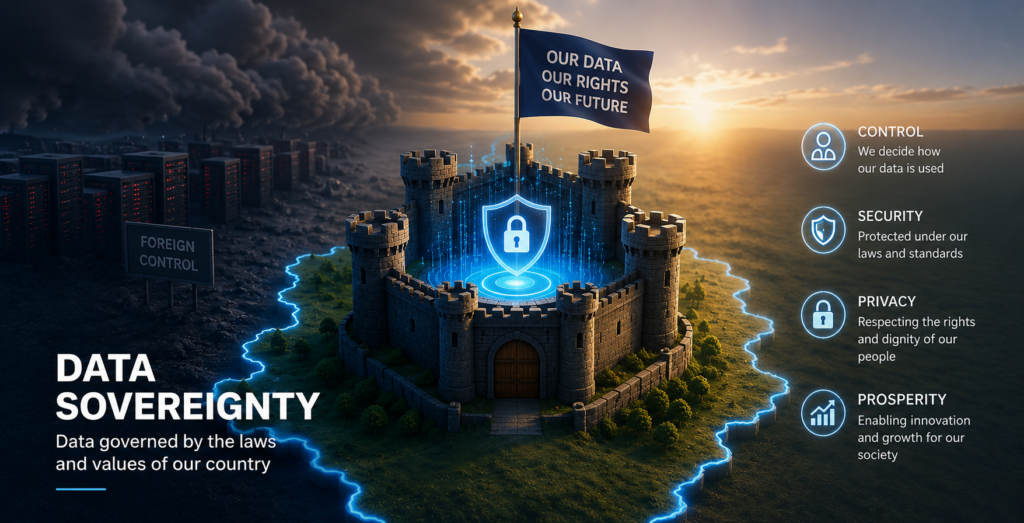
For many UK organisations, compliance with UK GDPR is treated as the finish line for data governance. If the privacy notices are updated, the transfer impact assessments completed, and the contracts signed, the assumption is that sensitive information is protected.
It is not.
GDPR was designed as a privacy framework, not a sovereignty framework. It regulates how personal data should be handled, but it does not guarantee where power over that data ultimately resides, who can compel access to it, or how foreign jurisdictions can reach into British infrastructure.
That distinction matters more now than at any point since Brexit.
Modern UK businesses increasingly operate on cloud infrastructure, AI platforms, analytics systems and SaaS products controlled by foreign companies, particularly American hyperscalers. In practice, this means enormous volumes of British commercial, health, financial and behavioural data are processed outside the UK or remain legally accessible from abroad, even when physically hosted in Britain.
GDPR Protects Privacy, Not Sovereignty
UK GDPR focuses on lawful processing, consent, transparency and safeguards for international transfers. It does not create true national control over data.
A company can be fully compliant with UK GDPR while still:
- Hosting data with a US corporation subject to the US CLOUD Act
- Processing customer information through overseas AI systems
- Replicating data across international regions for resilience or analytics
- Allowing foreign contractors administrative access to UK systems
- Feeding UK-origin data into multinational AI training pipelines
The legal structure permits these arrangements provided the correct mechanisms exist, such as adequacy decisions, Standard Contractual Clauses or the UK-US Data Bridge. (GDPR Advisor)
But sovereignty is about more than regulatory paperwork. It is about control.
If another state can legally compel access to the systems holding British data, sovereignty has already been diluted.
The CLOUD Act Problem
The clearest example is the US CLOUD Act.
The legislation allows US authorities to compel American technology firms to provide data under their control, regardless of where the data is physically stored. This means data located in London can still fall under US legal jurisdiction if the provider is American. (impossiblecloud.com)
This creates a structural contradiction for UK businesses.
A company may believe its data remains “in the UK” because the servers are in British datacentres, yet the legal authority governing access may still sit overseas.
This is not theoretical.
Major British organisations routinely depend on infrastructure owned or operated by US companies including Amazon Web Services, Microsoft Azure, Google Cloud and Salesforce. Even when contracts specify UK or EU residency, the parent company’s jurisdiction remains relevant.
The result is a gap between compliance and sovereignty.
The NHS and Palantir: A Sovereignty Warning
The NHS Federated Data Platform controversy demonstrates the problem in public view.
US analytics company Palantir Technologies secured a major NHS contract to help integrate healthcare data systems across England. Concerns escalated after reports revealed that external contractors could receive broad access to identifiable patient data through the platform. (Reuters)
The issue is not simply privacy. It is strategic dependence.
British health data, one of the country’s most sensitive national assets, is increasingly processed through infrastructure and tooling controlled by a foreign corporation closely associated with US defence and intelligence sectors. Critics have argued this weakens public accountability and national control over health information. (The Guardian)
Palantir insists it acts only as a processor under NHS instructions. Yet the controversy highlights a deeper issue: GDPR compliance does not eliminate geopolitical dependency.
A system can satisfy legal transfer requirements while still centralising operational power outside the UK.
UK Business Data Is Already Proliferating Abroad
Cross-border data movement is now embedded into normal business operations.
Research cited in 2026 found that nearly three quarters of surveyed UK enterprises transferred data outside the UK through AI systems at least weekly, while 61% admitted they lacked full visibility into how overseas processing occurred.
This is particularly significant because AI systems are fundamentally data-hungry.
Large language models, behavioural analytics platforms, fraud engines and recommendation systems frequently rely on globally distributed processing pipelines. Once data enters these ecosystems, tracing where it travels, how long it persists, and whether it contributes to model training becomes increasingly difficult.
GDPR requires accountability, but enforcement struggles to keep pace with the architecture of modern AI infrastructure.
Foreign Data Mining Operations Are Already Exploiting UK Data
The limits of GDPR become even clearer when examining foreign data mining operations targeting British citizens.
The most prominent example is Clearview AI.
Clearview scraped billions of publicly available images from across the internet, including photographs of UK residents, to build a facial recognition database marketed internationally. UK regulators argued the company unlawfully harvested and processed biometric data belonging to British citizens. (Verdict)
Importantly, Clearview operated outside the UK.
This demonstrates a critical sovereignty weakness: British data can be extracted, analysed and commercialised abroad long before UK regulators can intervene effectively.
Even where enforcement occurs, practical control remains limited. Jurisdictional disputes and appeals have repeatedly complicated attempts to regulate foreign companies processing UK-origin data. (Gowling WLG)
The same pattern appeared in the Facebook–Cambridge Analytica data scandal, where harvested behavioural data from UK and global users was exploited for political profiling and targeting. The scandal exposed how easily large scale behavioural datasets can move across borders into opaque analytics ecosystems. (Verdict)
Sovereignty Requires Technical and Strategic Control
Real data sovereignty requires more than regulatory compliance.
It requires:
- Infrastructure governed under UK jurisdiction
- Reduced dependency on foreign hyperscalers
- Transparent data lineage and processing visibility
- Limits on foreign administrative access
- Domestic capability in cloud, AI and analytics infrastructure
- Procurement policies that consider geopolitical exposure
- Technical architectures that minimise unnecessary international transfers
This is why many European policymakers increasingly distinguish between data protection and digital sovereignty. The two overlap, but they are not the same thing.
A British company may satisfy every GDPR requirement and still lose meaningful control over its information supply chain.
GDPR Is Necessary, But It Is Not Enough
GDPR remains important. Without it, organisations would have far fewer protections around misuse, transparency and accountability.
But GDPR was never designed to solve strategic dependence on foreign technology infrastructure.
The UK’s data economy now runs through multinational cloud providers, AI vendors and analytics firms whose legal obligations extend beyond British jurisdiction. As AI accelerates global data processing and governments expand extraterritorial access laws, the gap between compliance and sovereignty will continue to widen.
For UK organisations, the question is no longer simply:
“Are we GDPR compliant?”
It is:
“Who ultimately controls the systems our data depends on?”
To stay safe online use our NORDVPN link for a great discount.
