
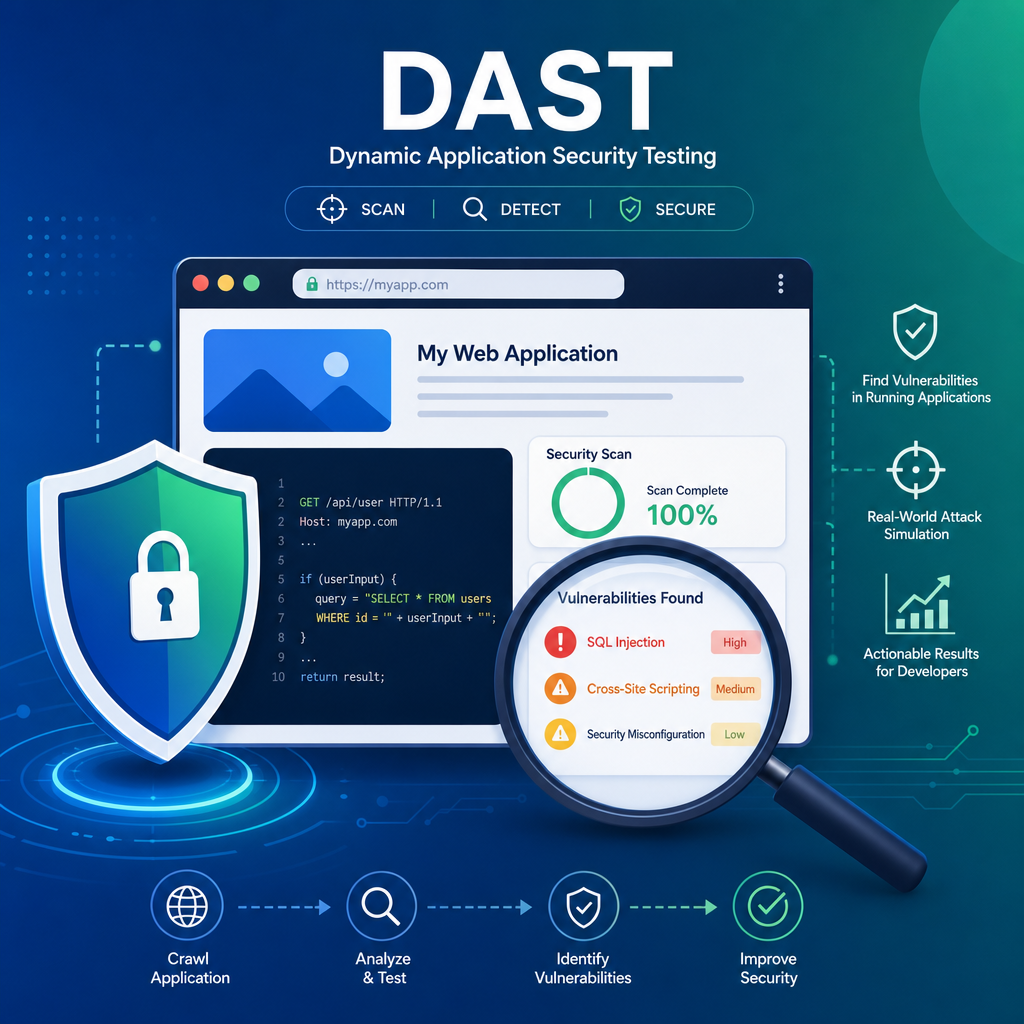
Introduction to DAST
What is DAST?
- Dynamic Application Security Testing (DAST) is a black-box testing method.
- It analyzes running applications to identify security vulnerabilities.
- Focuses on external threats without access to source code.
Why DAST is Important
- Detects vulnerabilities in real-time application environments.
- Helps prevent security breaches and data leaks.
- Complements other testing methods like SAST and IAST.
How DAST Works
DAST Testing Process
- Scanning: Automated tools scan the running application.
- Attack Simulation: Simulates attacks to find weaknesses.
- Vulnerability Identification: Reports security flaws.
- Remediation: Developers fix identified issues.
Types of Vulnerabilities Found
- SQL Injection
- Cross-Site Scripting (XSS)
- Authentication and Authorization Flaws
- Security Misconfigurations
Benefits of DAST
Key Benefits
- Detects vulnerabilities without source code access.
- Works on running applications in real environments.
- Automated and continuous testing capabilities.
- Improves overall security posture.
Best Practices for DAST
Effective DAST Strategies
- Integrate DAST into CI/CD pipelines.
- Regularly update testing tools and signatures.
- Combine with SAST and manual code reviews.
- Prioritize remediation based on risk level.
Common Challenges
Challenges in DAST Testing
- False positives and negatives.
- Limited visibility into application internals.
- Performance impact during testing.
- Complex configuration requirements.
Conclusion
Summary
- DAST is essential for proactive security testing.
- It identifies vulnerabilities in running applications.
- Should be part of a comprehensive security strategy.
