
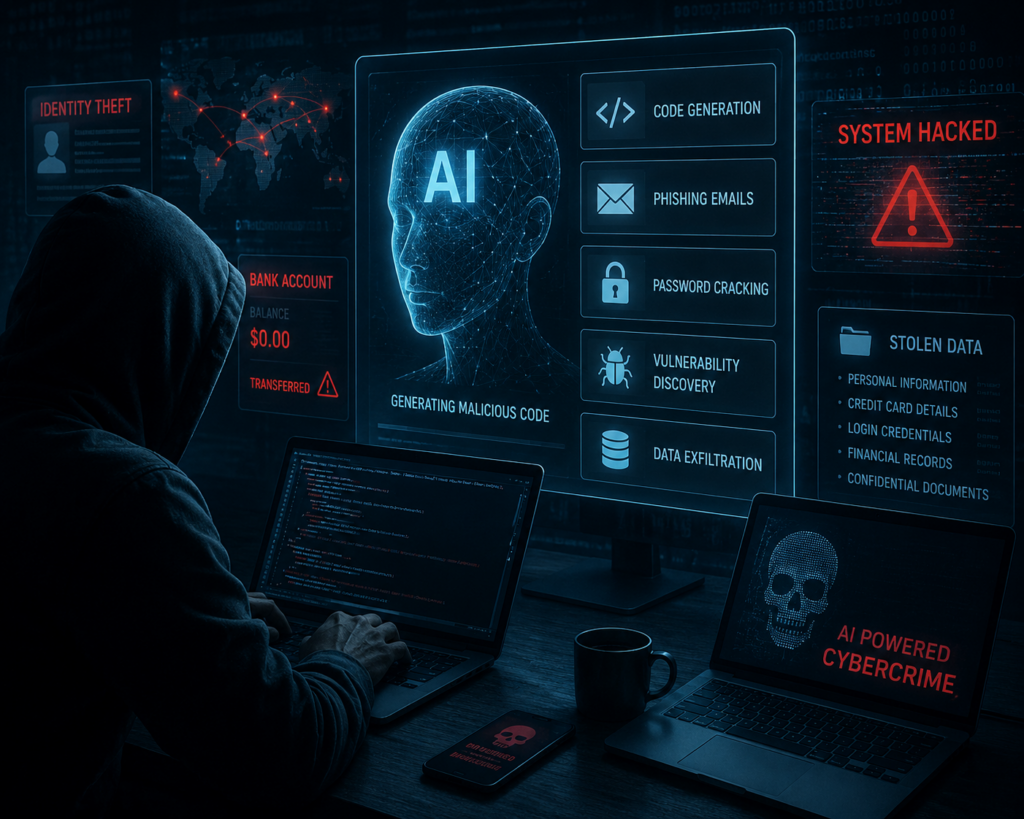
Artificial intelligence has transformed countless industries, from healthcare and finance to entertainment and education. Unfortunately, cybercriminals have also embraced AI with enthusiasm. Though it may seem straight out of science fiction AI crime agents are very real. In 2026, cybercrime is becoming faster, smarter, and more convincing than ever before, if you’d told me as a child I’d need to be concerned with getting hacked by a robot, I don’t think I’d believe you, but here we are.
However it’s not all bad news, AI is also helping security professionals fight back. Businesses, governments, and cybersecurity experts are using advanced tools to detect threats earlier and respond more effectively.
It is basically a technological arms race, except instead of robots with laser cannons, everyone is arguing over suspicious emails and forgotten passwords.
The Rise of AI-Powered Cybercrime
Cybercriminals once relied heavily on manual techniques, recycled scams, and malware copied from shady internet forums. AI has changed that dramatically.
Attackers can now automate large parts of their operations, allowing them to target more victims with greater precision. AI systems can analyse huge amounts of data, mimic human communication, and adapt attacks in real time.
In the past, scam emails were fairly easy to spot because they looked like they had been written during a power cut with boxing gloves on. In 2026, many phishing emails are polished, convincing, and grammatically correct. Frankly, some are better written than office newsletters.
Smarter Phishing Attacks
Phishing remains one of the most common forms of cybercrime, but AI has made these scams far more believable.
AI tools can now:
- Generate realistic emails in fluent English
- Mimic writing styles from colleagues or managers
- Create fake invoices and documents
- Personalise messages using publicly available information
Some scams even use AI-generated voice cloning to imitate company executives or family members. Fraudsters have used these techniques to trick employees into transferring money or revealing sensitive information.
Imagine getting a voicemail from your boss asking for urgent payment authorisation, only to discover later your boss was actually on holiday arguing with a hotel buffet toaster, stranger things can happen these days.
Deepfakes Are Becoming a Serious Threat
Deepfake technology has improved significantly in recent years. AI can now generate realistic video and audio recordings that are difficult to distinguish from genuine content.
Cybercriminals are using deepfakes to:
- Impersonate executives during video calls
- Spread misinformation
- Blackmail individuals
- Bypass identity verification systems
As these tools become more accessible, experts expect deepfake-related fraud to increase substantially.
Unfortunately, “I never said that” is becoming less convincing when there is a high-definition video apparently showing you saying exactly that.
AI-Driven Malware and Ransomware
Modern malware is becoming increasingly adaptive. AI-powered malicious software can change its behaviour to avoid detection, identify valuable targets, and exploit vulnerabilities more efficiently.
Ransomware gangs are particularly interested in AI because it allows them to:
- Scan networks rapidly
- Identify critical systems
- Customise ransom demands
- Automate negotiations with victims
Some criminal groups are even using chatbots to handle ransom communications. Nothing says “the future has arrived” quite like negotiating with an AI customer support bot that has kidnapped your files.
Automated Hacking at Scale
AI allows attackers to automate tasks that once required skilled human hackers.
This includes:
- Password cracking
- Vulnerability scanning
- Social engineering
- Credential stuffing attacks
- Data harvesting
Automation means attacks can happen at a much larger scale and at far greater speed. Small businesses, which were once considered less attractive targets, are increasingly vulnerable because automated systems can target thousands of organisations simultaneously.
Even the local bakery now needs cybersecurity protection. Somewhere out there, a hacker is probably trying to ransom a sourdough recipe.
The Growing Threat to Businesses
Businesses in 2026 face a more complicated cyber threat landscape than ever before.
AI-enhanced attacks can lead to:
- Financial losses
- Data breaches
- Operational disruption
- Reputational damage
- Legal and regulatory penalties
Industries handling sensitive information, such as healthcare, banking, and legal services, are especially at risk.
Many organisations are now investing heavily in cybersecurity training and AI-powered defence systems to keep pace with ever evolving AI powered threats.
Unfortunately, half the office cybersecurity training still involves reminding people not to use “Password123” rather than more a specialised LMS.
How AI Is Fighting Cybercrime
While cybercriminals are using AI aggressively, cybersecurity professionals are also benefiting from the technology.
AI has become one of the most powerful tools in modern cyber defence.
Threat Detection in Real Time
Traditional security systems often relied on known attack signatures. AI systems can detect unusual behaviour and identify suspicious activity far more quickly.
AI-powered monitoring tools can:
- Detect unusual login patterns
- Identify malware behaviour
- Flag suspicious network traffic
- Recognise account takeovers
- Respond to attacks automatically
This allows organisations to react before significant damage occurs.
For example, if someone logs into your account from another country at 3am and immediately tries to buy six laptops, well made AI systems are programmed to become slightly suspicious.
AI-Powered Fraud Prevention
Banks and financial institutions are increasingly using AI to detect fraud in real time.
These systems analyse transaction behaviour and can quickly identify unusual activity, such as:
- Purchases in unfamiliar locations
- Sudden spending spikes
- Suspicious login attempts
- Fake account creation
Many fraud detection systems can block transactions automatically while investigations take place.
Smarter Email and Phishing Protection
AI is improving spam filters and phishing detection systems significantly.
Modern security tools can analyse:
- Writing patterns
- Suspicious links
- Domain impersonation
- Malicious attachments
- Behavioural anomalies
This helps prevent dangerous emails from reaching inboxes in the first place.
Although somehow, promotional emails from shops you visited once in 2018 still manage to survive every filter imaginable.
Automated Incident Response
When attacks occur, speed matters. AI can help security teams respond more rapidly by automating routine tasks.
This includes:
- Isolating infected devices
- Blocking malicious IP addresses
- Revoking compromised credentials
- Prioritising critical alerts
Automation reduces response times and allows human analysts to focus on more complex threats.
Without automation, some IT departments would still be working through alerts from last Tuesday.
The Human Factor Still Matters
Despite rapid advances in AI, human judgement remains essential in cybersecurity.
Employees still need training to recognise scams, use strong passwords, and follow good security practices. Many successful attacks continue to exploit human error rather than technical weaknesses.
AI may be sophisticated, but it still cannot stop someone clicking a link labelled “HOT BABES IN YOUR AREA ARE LOOKING FOR LOVE”.
Ethical and Legal Challenges
The growing use of AI in cybersecurity also raises ethical and legal concerns.
Questions include:
- How should AI-generated content be regulated?
- Who is responsible when AI systems make mistakes?
- How can privacy be protected while monitoring threats?
- What safeguards are needed against misuse?
Governments around the world are racing to develop laws and regulations that address these issues without slowing innovation.
As usual, technology is moving at lightning speed while legislation is still looking for its reading glasses.
Looking Ahead
AI will continue reshaping cybercrime throughout the coming years. Both attackers and defenders are becoming more sophisticated, and the balance between offence and defence is constantly shifting.
For businesses and individuals alike, cybersecurity can no longer be treated as an afterthought. Awareness, training, and modern security tools are now essential.
The cyber threats of 2026 may look very different from those of a decade ago, but one thing remains certain: somewhere, right now, an IT professional is begging someone not to reuse the same password for everything.
To learn more about staying safe online check out our helpful courses, or to stay up to date with us follow on linkedin.
