
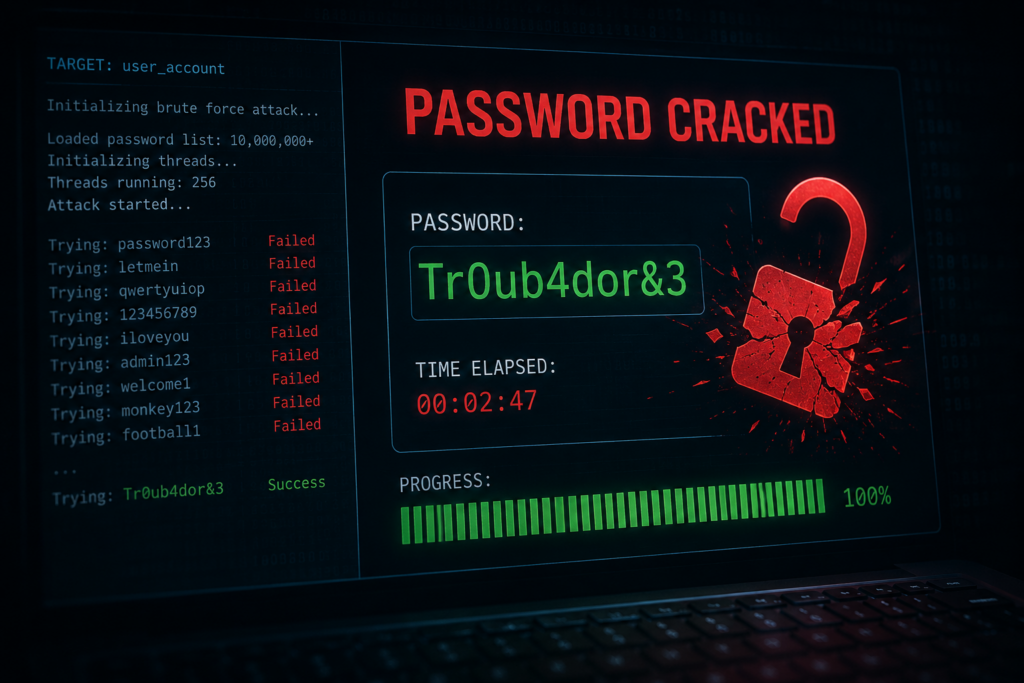
For years, internet users have been told the same thing:
Use a strong password.
So people obediently created passwords like:
Tr0ub4dor&3!
Then immediately forgot them, reset them twice, wrote them on a Post-it note, and carried on with their day.
The truth is that “strong passwords” are not nearly as effective as most people think. In fact, many cyber attacks have very little to do with password complexity at all. Cyber criminals are not sitting in dark rooms manually guessing your cat’s name while dramatic music plays in the background. Most attacks are automated, opportunistic and surprisingly simple.
A password can technically be strong and still completely useless.
Here is why.
The Biggest Problem Is Not Weak Passwords. It Is Reused Passwords.
People rarely use one password.
They use one password everywhere.
Perhaps with minor variations:
London123London123!London123!!PleaseLeaveMeAlone
This creates a domino effect. If one website suffers a data breach, attackers test the same email and password combination across hundreds of other services. This is called credential stuffing, and it works alarmingly well.
A leaked password from an old forum you joined in 2014 to discuss barbecue techniques can eventually compromise your email, banking apps or cloud storage.
The irony is that the password itself may have been technically “strong”. It just was not unique.
Complexity Rules Created Terrible Habits
For years, websites demanded:
- one capital letter
- one number
- one symbol
- no repeated characters
- no dictionary words
- the blood of a medieval wizard
The result was not better security. It was predictable behaviour.
Humans are creatures of habit. When forced to create complex passwords, most people follow patterns:
- replacing “a” with “@”
- adding “123”
- capitalising the first letter
- putting an exclamation mark at the end
Cyber criminals know this because password cracking tools are designed around human laziness. Unfortunately, humans are highly consistent in their inconsistency.
Your Password Is Often Not the Thing Being Attacked
Many modern scams bypass passwords entirely.
Consider phishing emails. A fake Microsoft or Netflix login page appears legitimate enough that users willingly type in their credentials themselves. No hacking required.
It is less “Mission Impossible” and more “someone politely asking for your wallet”.
Attackers also exploit:
- fake password reset links
- SIM swap attacks
- stolen browser cookies
- malware
- social engineering
- leaked authentication tokens
In these situations, even the world’s strongest password offers limited protection.
A 40-character masterpiece means very little if you hand it over to a fake login page because you were distracted while drinking tea and answering emails simultaneously.
Security Questions Are Often Ridiculous
Even when passwords are secure, recovery systems frequently are not.
Many websites still ask questions such as:
- What was your first school?
- What is your mother’s maiden name?
- What was your first pet called?
In the age of social media, these are less security questions and more pub quiz answers.
People voluntarily upload their birthdays, schools, pets, holidays and family history online every day. Attackers no longer need sophisticated hacking techniques when Facebook provides half the answers for free.
The Human Brain Is Not Designed for Password Management
The average person now has dozens, if not hundreds, of online accounts.
Expecting people to remember:
- unique passwords
- long passwords
- random passwords
- regularly updated passwords
for every account is unrealistic.
This is why people:
- reuse passwords
- save them in browsers
- write them in notebooks
- store them in phone notes titled “Definitely Not Passwords”
Cybersecurity advice often assumes humans behave like encrypted databases. They do not.
They behave like tired people trying to log into their electricity provider at 10:47 pm.
Password Expiry Rules Made Things Worse
Many companies used to force password changes every 30 or 90 days.
Employees responded predictably:
Winter2024!Spring2025!PleaseStopMakingMeDoThis1
Frequent forced resets often encourage weaker behaviour because people prioritise memorability over security.
Modern cybersecurity guidance increasingly recommends longer, unique passwords instead of constant mandatory changes unless there is evidence of compromise.
So What Actually Works?
The good news is that password security is not hopeless. The bad news is that the solution is slightly less exciting than Hollywood hackers.
Use a Password Manager
Password managers generate and store unique passwords for every account.
This means you only need to remember one strong master password instead of attempting to memorise 137 variations of:
BiscuitMonkey88!
Password managers are not perfect, but they are vastly safer than password reuse.
Turn On Multi-Factor Authentication
Multi-factor authentication, often called MFA or 2FA, adds another layer of security beyond your password.
Even if attackers steal your credentials, they still need access to:
- your phone
- authentication app
- security key
- biometric verification
It is not invincible, but it dramatically reduces risk.
Think of passwords as a front door lock and MFA as a second locked door behind it. Slightly inconvenient for you. Extremely annoying for criminals.
Longer Beats Stranger
A long passphrase is often stronger and easier to remember than a short, complicated password.
For example:
TeaRainTrainsLibraryWindow
is generally better than:
T#7xQ!2
One looks like abstract poetry. The other looks like a printer malfunction.
The Future May Be Passwordless
Tech companies are increasingly moving towards passkeys, biometrics and device-based authentication.
The goal is simple:
remove humans from password creation entirely because, statistically speaking, humans are the weak point.
Which sounds harsh, but also fair considering millions of people still use:
123456passwordqwerty
and somehow remain surprised when hacked.
Final Thoughts
The myth of the “strong password” persists because it sounds simple. Create a complicated password and you are safe.
Reality is messier.
Most breaches happen because of:
- password reuse
- phishing
- poor recovery systems
- social engineering
- human behaviour
Cybersecurity is not just about technical strength. It is about reducing opportunities for mistakes.
And ideally doing so without forcing people to remember whether their password contains:
- one uppercase letter,
- two symbols,
- a Japanese hiragana character
- And a Norse rune
to learn more about staying safe online check out our helpful courses, or to stay up to date with us follow on linkedin.
