
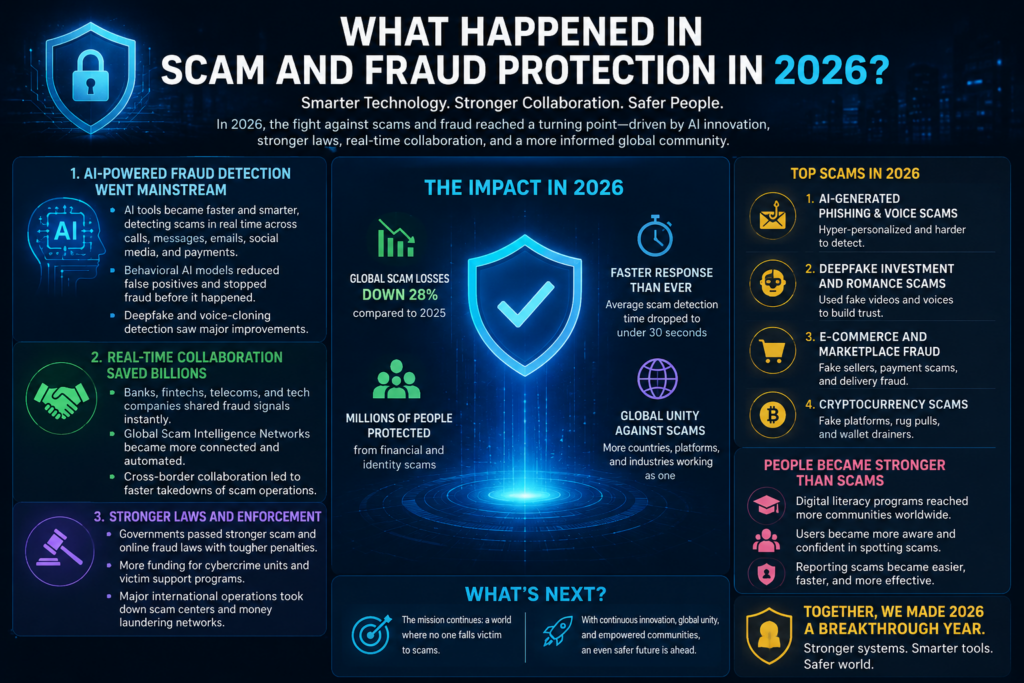
Fraud protection changed sharply in 2026. Criminals kept moving faster, using AI, automation, and convincing impersonation tactics to make scams harder to detect, while banks, governments, and payment networks responded with tighter controls, stronger reimbursement protections, and more real-time fraud detection.
The biggest story of the year is that scams became more believable. Fraudsters increasingly used AI to scale voice cloning, fake video calls, targeted phishing, and payment scams, which made it much harder for consumers and businesses to tell a real request from a fake one. At the same time, defenders shifted toward behavioral analytics, device intelligence, and predictive AI to catch suspicious activity before money left the account.
A second major change was the growing industrialization of fraud. Mastercard’s 2026 reporting said payments fraud is becoming more automated and sophisticated, with criminal tooling increasingly standardized and scaled like a service model. LexisNexis also highlighted fraud-as-a-service, money mule networks, fragmented identity data, and the “good vs. bad” AI arms race as core 2026 trends.
Payment scams remained a major concern. Authorized Push Payment, or APP fraud, continued to be a key issue because victims are tricked into authorizing transfers themselves, which makes recovery harder than with unauthorized card fraud. In the UK, the protection landscape became especially important because reimbursement rules for many APP scams are now embedded in the payments environment, changing expectations for banks and victims alike.
Government policy also moved forward in 2026. The UK published its Fraud Strategy 2026 to 2029, built around disrupting criminal networks, safeguarding the public, and improving response and recovery. That strategy reflects a broader shift in fraud policy: prevention is no longer just about blocking transactions, but also about cutting off mule accounts, payment pathways, and the infrastructure that supports scams.
Consumer losses remained alarmingly high. The FTC reported more than $12.5 billion in fraud losses in 2024, up 25% from 2023, and later testified that fraud losses in 2025 rose to $15.9 billion. Those figures reinforce a key point for 2026: fraud protection is no longer a niche compliance issue, but a mainstream trust and safety problem affecting households, banks, retailers, and online platforms.
For businesses, 2026 made one thing clear: old fraud controls are not enough. Static rules and manual reviews cannot keep up with AI-generated deception, fast payment rails, and identity fraud that crosses channels and devices. Organizations are increasingly adopting layered defenses, including real-time monitoring, stronger authentication, shared intelligence, and better collaboration between fraud, compliance, and security teams.
For consumers, the advice is simple but more important than ever. Verify requests independently, slow down when money is urgently requested, use strong multi-factor authentication, and never trust a call, text, or video just because it sounds familiar. In 2026, the safest assumption is that a scam can look polished, personal, and professional enough to fool even careful people.
FAQ
What was the biggest fraud trend in 2026?
AI-powered impersonation, deepfakes, and automated scam campaigns were among the biggest fraud trends in 2026.
Did fraud protection improve in 2026?
Yes, but mainly through stronger real-time detection, broader collaboration, and policy changes rather than one single breakthrough.
Why was APP fraud such a big topic in 2026?
Because it targets people into authorizing transfers themselves, making prevention and reimbursement more complex than ordinary card fraud.
What should businesses prioritize first?
Real-time monitoring, AI-driven anomaly detection, stronger identity verification, and mule-account disruption.
